
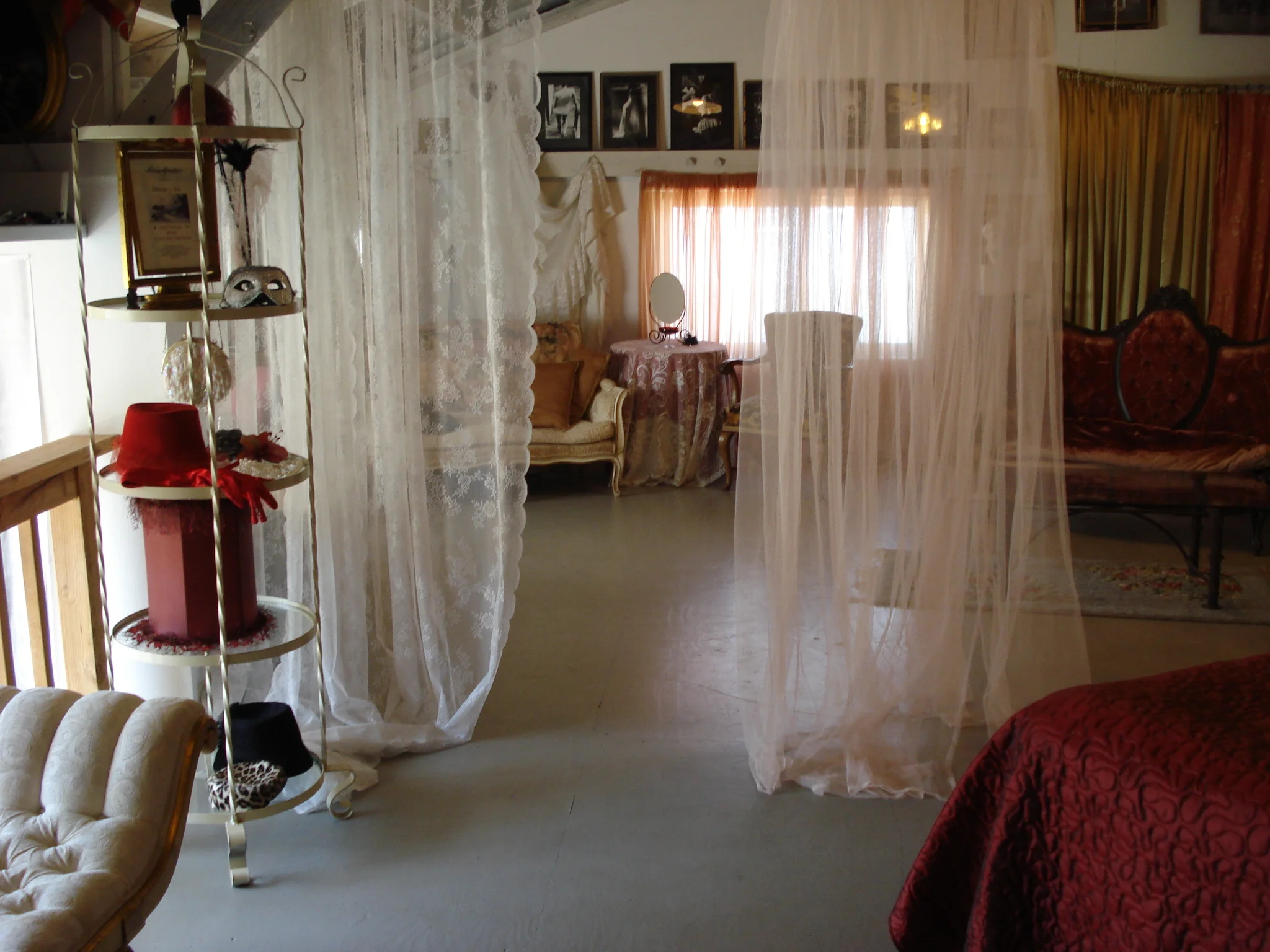
Lolo's Boudoir
2004–2013 · Sausalito, California
There are spaces we leave behind, but somehow never quite leave us.
Like most marvelous things in life, Lolo’s began with an innocent idea.
I had bought an old Nikon F2 because I wanted to take “real pictures” and explore black and white photography. My then husband's birthday was coming up and I wanted to surprise him with a book of sexy photographs of myself.
Inspired by my mother-in-law's ornate home, I'd transformed our bedroom into a lush little boudoir, complete with a four-poster bed, cranberry red walls and a candelabra. On a spontaneous note, I asked a friend to photograph me.
At first I felt like a deer in headlights, awkward and shy. But a boa of black frivolous feathers around my neck somehow woke up my inner superstar. Soon I was sexy, sassy, silly and silky.
As dormant facets of my womanliness came to life, the initial idea of making my guy remember the woman he fell in love with lost its importance.
I was fast falling in love with myself.
The next day I returned the favor and photographed my friend. We laughed and had so much fun, agreeing that this was such a liberating experience, something every woman should give herself.
The seed to Lolo's Boudoir was sown.
In 2004 I officially opened Lolo's Boudoir in Sausalito — a safe space for women to explore themselves away from the prying eyes of the public.
The name and concept came from my alter ego Miss Lolo, the archetype of a liberated, sensual woman, from Virginia Woolf's A Room of One's Own, and from the lush French boudoirs that added a touch of sensuality and decadence.
I must have hit a need amongst women.
Over more than a decade, hundreds of women of all ages, shapes and walks of life found their way to Lolo's. Some came to celebrate themselves. Some came because they were curious. Some came after divorce, motherhood, loss or change. Some had spent years struggling with their bodies or their sense of themselves.
And some simply came because it sounded like fun.
I never quite knew who would walk through the door.
And that was part of the magic.
Learning to see and be seen
Something happened when I picked up the camera and asked a woman to “get naked” and show herself.
There was no place to hide, neither for her nor for me. The seen and the seer.
Her shames, scars and insecurities would often show up without words: a defended chest, eyes looking away, rigid hips, a smile that didn't quite belong.
The more women I photographed, the more I realized that my job wasn't really about photographing a beautiful woman.
It was about teasing out the woman within.
Less about composing the perfect image and more about creating a safe space where she could explore and express herself on her own terms.
We played. We talked. We laughed. We fumbled our way through the tender terrain of body, beauty, sexuality and womanhood.
And somewhere along the way, the camera became a catalyst for authenticity.
Everyone longs to be seen, but most of us are terrified of seeing ourselves as we are.
The camera, and the nakedness it implied, gave us a way past the usual postures and pretense. A way into something more honest.
Sometimes a woman arrived with a very clear idea of how she wanted to look.
Sometimes she had no idea at all.
Either way, we discovered her together.
Beyond the boudoir
After some years, I felt a need to move beyond the boudoir itself. I no longer wanted women to hide within an ornate setting, lacy attire and heels.
I wanted the contrast.
The rawness.
The freedom of the great outdoors, or the rustic, barren and magical barn beside my home.
Nature became more than a backdrop. It became part of the work.
Out there, there was less to perform and less to control. The body could move, breathe, get dirty, disappear into the landscape or take up space within it. The encounter became less about how a woman looked and more about how she felt, sensed and inhabited herself.
This is still central to my work today.
I am interested in what happens when we loosen our grip on the stories we carry about ourselves — how we should look, behave, age, desire, or be seen — and allow something more instinctive to emerge.
Being in nature helps with that. It gives us somewhere to go beyond the mirror, beyond the image, and sometimes beyond the story we have been telling about ourselves.
The early years I primarily shot 35mm film. Even when I moved into digital, I continued to work with natural light and without retouching bodies or applying fancy filters.
I loved the honesty of it — the way light can illuminate, shade, reveal and disguise. The way a real person can be so much more interesting than an idea of perfection.
Many sessions felt like blind dates. I often hadn't met the woman beforehand, didn't know the location or have any control over the weather or the light.
It taught me to trust the creative process.
To show up empty, available and ready for discovery.
It taught me that whatever we each brought was enough.
Magic never failed us.
And perhaps the best way to see someone, intimately and honestly, is to fall a little bit in love with them.
What I didn't know I was photographing
I thought I was photographing women.
I was also photographing a particular moment in time.
The early years of social media. The rise of the selfie. An increasingly relentless image culture. The beginning of much bigger conversations about the female gaze, body image, sexuality, self-representation and who gets to look at whom.
At Lolo, I saw firsthand how complicated our relationship with our bodies could be.
For ages, the female body has been a global icon, revered for its beauty, allure and incredible ability to give life. And yet it has also been a battlefield of so many kinds — religious, economic, gendered, sexual, commercial, cultural, and sometimes simply a battlefield between a woman and herself.
These were not abstract ideas.
They were sitting in front of my camera.
In hundreds of different bodies.
And in those intimate encounters, I began to understand that the photographs we were making were not really about being sexy.
They were about permission.
Permission to play.
Permission to be seen.
Permission to inhabit a body without apologizing for it.
Permission to change one's mind about oneself.
We needed to create these images so that we could step into them.
We needed to reimagine ourselves, rekindle a sense of reverence for the female body and self, and come alive inside our own skin.
Closing the door
At the end of 2013 I closed the studio in Sausalito and returned to my Nordic roots.
The physical space disappeared, but the questions Lolo had opened up did not.
I went on to make Embody, the book that grew out of many of those years, and I continued photographing, gradually moving further beyond the boudoir and into the landscape.
The setting changed, but the exploration continued.
I became less interested in photographing an idea of femininity and more interested in what happens when we step outside the stories we have been given about ourselves.
Lolo, now
We live in a very different image culture today.
We carry cameras with us everywhere. We construct, edit, share and constantly encounter images of ourselves and each other. We have more possibilities than ever to decide how we want to be seen, and at the same time we are surrounded by increasingly narrow and commercial ideas of what a body, a woman, beauty or desirability should look like.
The question of the gaze has not disappeared. If anything, it has become more complicated.
Who is looking?
Who are we performing for?
And what happens when we stop performing altogether?
These questions still inform my work.
I still photograph women, bodies and the human experience of being seen. Increasingly, I do so outdoors, where the landscape becomes part of the encounter and there is room for something less constructed to emerge.
Lolo's Boudoir was one chapter in that ongoing exploration.
This is where I keep some of its history, photographs and stories — as a reference, a memory, and perhaps a little inspiration for what might come next.
Beyond the boudoir.